If you are reviewing an existing Jetson Nano design or planning a new edge AI device, ArmSoM AIM7 is an alternative platform worth evaluating.
The key is to compare complete application paths—not just processor specifications or module dimensions.
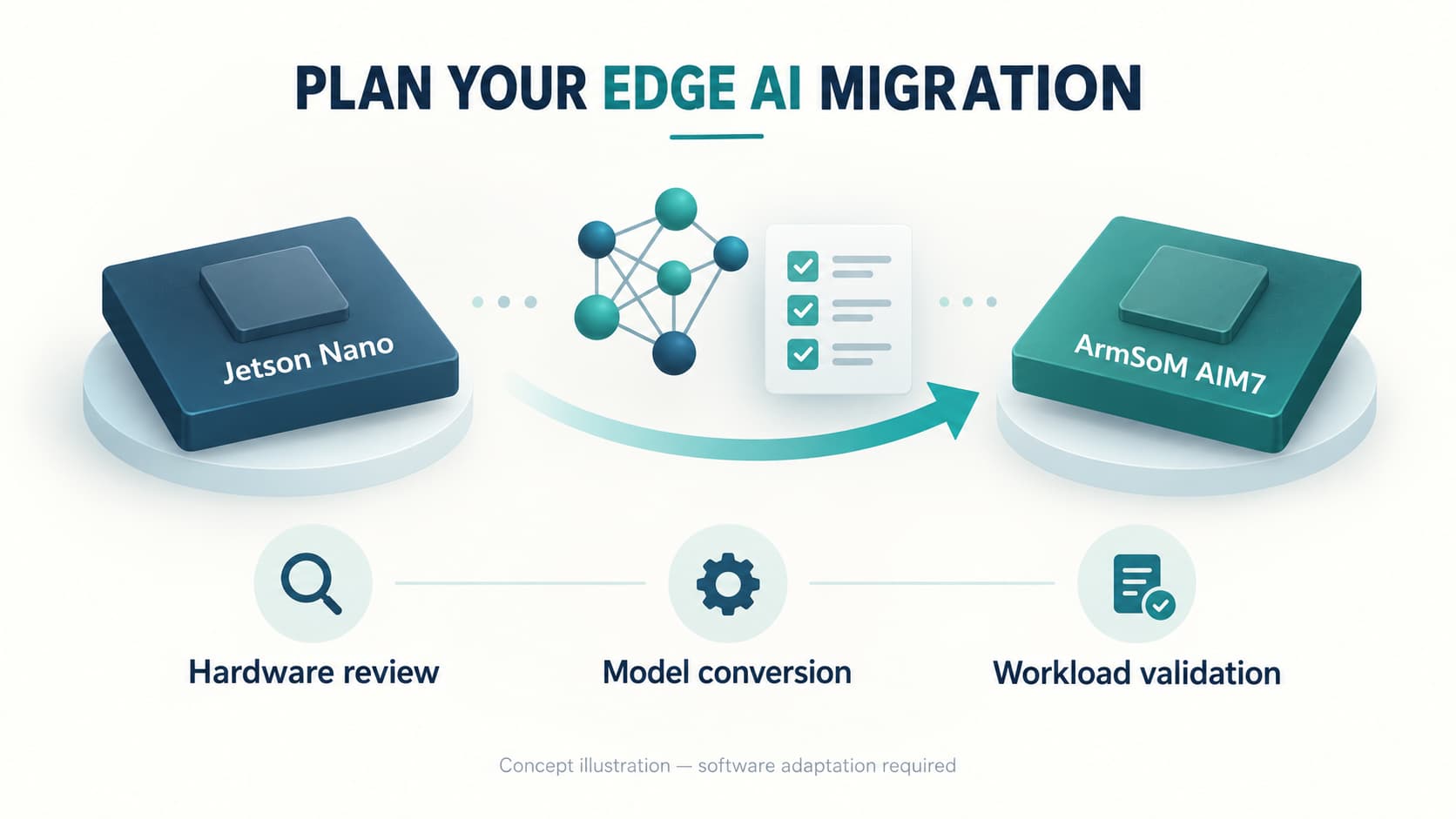
A different platform for edge AI
ArmSoM AIM7 is based on the Rockchip RK3588 and includes an NPU rated at up to 6 TOPS. ArmSoM describes its interface as compatible with Jetson Nano and documents a 260-pin edge-connector form factor. See the AIM7 specifications and pin definitions.
That provides a reason to investigate hardware reuse. It does not establish that every Nano carrier, peripheral or software component will work without changes.
Also distinguish the Jetson Nano module from a complete developer kit: the module and carrier must be evaluated together.
Hardware compatibility is only the first layer
Before powering a new module on an existing carrier, check the exact board revision against the module documentation.
Review power input, control signals, pin assignments, interface routing and mechanical clearance. Pay particular attention to the interfaces your application depends on, such as CSI cameras, displays and PCIe devices.
Begin with a documented carrier configuration where possible. Then validate the intended carrier one function at a time.
Plan for a software migration
Jetson Nano belongs to NVIDIA’s JetPack software ecosystem. Moving to an RK3588 platform means reviewing dependencies on NVIDIA-specific components rather than expecting the original system image to transfer unchanged. See NVIDIA’s Jetson Nano overview.
An application using CUDA kernels or TensorRT needs an appropriate migration plan. A saved TensorRT engine should not be treated as a portable Rockchip deployment artifact.
For supported neural-network workloads, Rockchip provides RKNN-Toolkit2 for tasks including model conversion and deployment preparation, with RK3588 among its supported platforms. Check your model against the current toolchain’s requirements and supported operations. See the official RKNN-Toolkit2 repository.
Compare the same workload
Do not turn a TOPS figure into an assumed frame rate or compare it directly with a GPU FLOPS figure.
Use the same representative input data and compare:
- Output accuracy.
- End-to-end latency.
- Sustained throughput.
- Memory use.
- Power and thermal behavior under the intended workload.
Include capture, preprocessing and postprocessing—not just inference.
When is AIM7 worth a closer look?
AIM7 is a candidate when your team can adapt platform-specific components and validate the application on Rockchip’s software stack.
If the project depends heavily on CUDA-specific code or proprietary Jetson-only components, account for that engineering work before deciding to migrate.
Considering an AIM7-based alternative to Jetson Nano? Share your carrier, camera, model format and CUDA or TensorRT dependencies. That information makes it possible to discuss a realistic migration path.